17/02/2011

things fall apart.

so, things have not been very good at casa mitchell this week. the usual family dramas, reopening of old wounds, and me sinking back into my role as introspective and silent eldest daughter like something straight out of virginia woolf. it's not a place i like to be, or a place that many people who see my day-to-day personality imagine me being, but it is a place i end up a lot, when i'm under the same roof as my family. part of it is because i can understand how all the things that make me myself are very disappointing to my parents. no self-respecting suburban (albeit divorced) pair want to raise a literary, liberal, vegetarian gender theorist who refuses to have sensible hair. that doesn't mean i'm any less proud of myself for what i've achieved, but it does mean i'm sometimes called upon to walk on eggshells and furiously negotiate everything internally before i say it. it's just how things are. families, who'd have them?

i'm not sure how far i'd go in my adherence to the like water for chocolate school of thinking about cooking; the idea that how you feel is imparted into what you make, but there are a few instances in my cooking life that have led me to wonder if it can, sometimes be the case (incidentally said book is quite an interesting female take on latin american magical realism, worth a read, for those interested in such things). these are instances where i have monumentally fucked up. or at least, something has. everyone experiences those moments in cooking where the magic just will not happen, and the more you try and the more frustrated you get, the worse you make things. they just seem to happen to me on what are already pretty horrible days where everything else goes completely tits up as well.

i feel, in some ways, that writing about this particular mistake is going to bring me serious relief. at the moment i have a lot of friends who have just started cooking; and while i appreciate them coming to me for advice; they seem to be on the dangerous verge of viewing me as infallible in the kitchen. i don't think it's healthy to strive to be or learn from anybody who never fucks up or never admits to it, which is why at university i preferred cynical broken marxists, and why in the kitchen i prefer almost documentary writers like mr. slater, who will freely admit to disastrous combinations and what-was-i-thinking moments? although, perversely enough i did use a nigel slater recipe for tuesday's kitchen disaster, which i have slightly rewritten here because i do everything by hand and nigel slater takes the machine approach to his cakes a lot of the time. so, from the kitchen diaries comes:


frosted marmalade cake (also known as 'oh my god what the fuck happened to that?!)

butter, 175g
golden unrefined caster sugar, 175g
a large orange
eggs, 3 large
orange marmalade, 75g (note here i am using my orange and glenturret home made)
self-raising flour, 175g

for the frosting:
icing sugar, 100g
orange juice, 2 tablespoons

set the oven at 180 degrees c/gas 4. line a loaf tin about 25 x 11 cm and 7cm deep. cream the butter and sugar until light and fluffy. finely grate the orange. break the eggs into a small bowl and beat lightly with a fork. beat the eggs into the butter and sugar a little at a time, then beat in the marmalade and the grated orange zest.

fold in the flour firmly but carefully with a large metal spoon. this may take a while. lastly, gently stir in the juice of half the orange. spoon the mixture into the lined tin, lightly smoothing the top . bake for forty minutes, checking it after thirty-five with a metal skewer. leave to cool in the tin for ten minutes, then cool completely on a wire rack.

sift the icing sugar and mix it to a smooth, runny consistency with as much of the remaining orange juice as it takes, probably just under two tablespoons. drizzle the icing over the cake, letting it run down the sides, and leave to set.
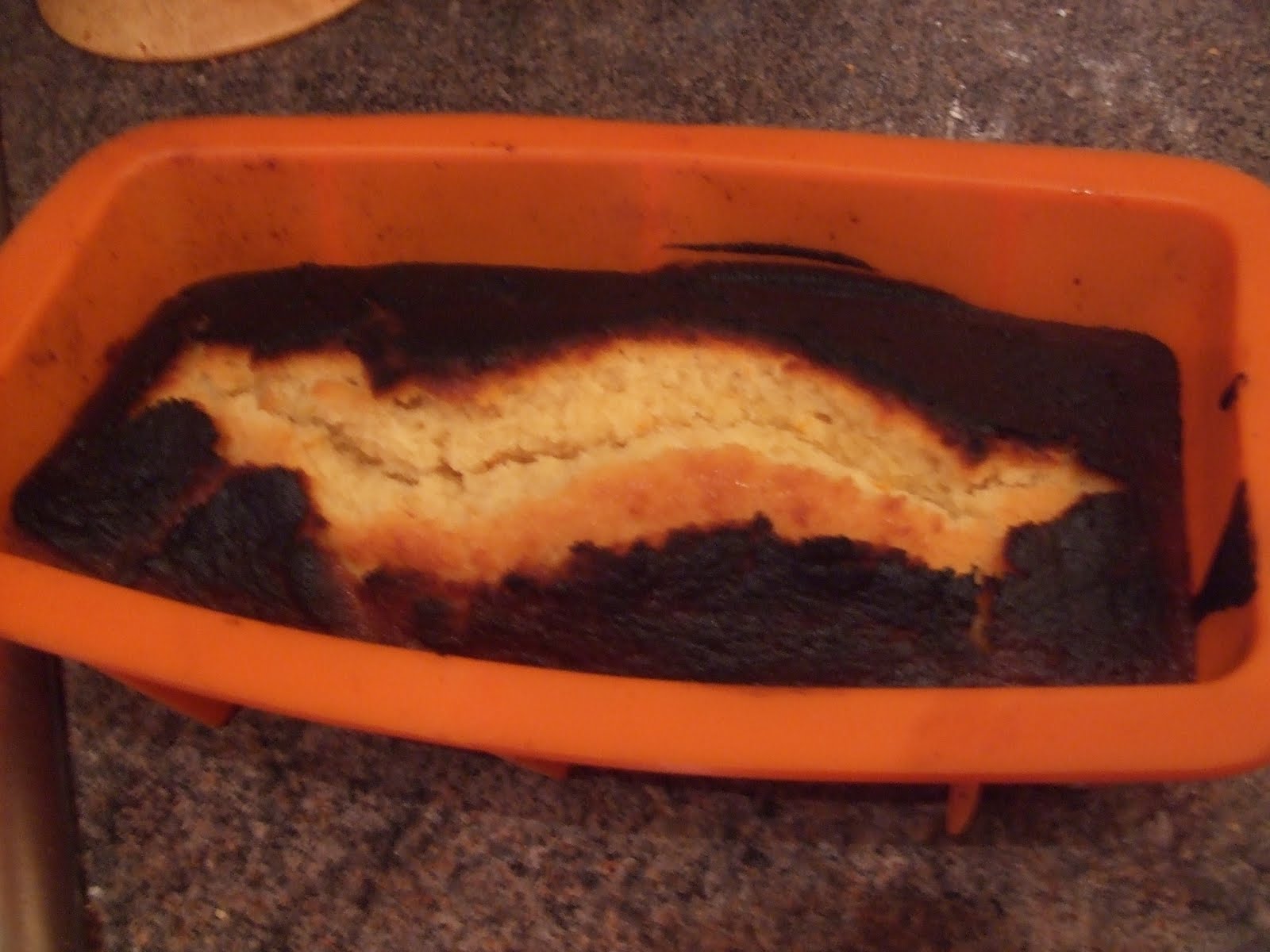
okay so i can already hear everyone thinking 'that seems like an easy recipe, what the hell went wrong?'. well, guys, this is what went wrong:

just....look at it. there was much countertop slamming and swearing afoot in my kitchen that afternoon. combined with panicky texts to ed varying in drama levels. what went wrong was i decided, rather than use the bane of my existence fan assisted main oven, to use the top oven. which then proceeded to unleash fury on the top of my cake. it would have been worse if i hadn't covered the top with foil.

(also, to those of you wondering exactly what the fuck my loaf tin is and why it's bright orange; it's silicone, i got it from a denby/le creuset outlet shop in gunwharf quays, portsmouth, along with several other silicone pieces, that i now refuse to be without in baking as they minimize the need for tin-lining thus earning me a fair few green points given how often i bake.)

still, nobody puts mitchell in a corner, not even a charcoal topping on a cake. and everything else in my day had started to go so downhill that this cake became a grudge point. i'm currently ill-advisedly reading a jonathan franzen during a time of family conflict, and he often uses his character's interactions with food to show what they're feeling. there's a bit in the corrections where an angry father fights with a barbecue in the rain and serves the most hilariously/tragically strained attempt at a mixed grill to his family while they're all silently against him. this cake was, by this point, that kind of metaphor. i cut off the top with a breadknife, increasingly frustrated in my efforts so that gentle sawing verged on manic hacking, turned the whole thing over, and proceeded to make my icing. i say icing, slater is being a bit disingenuous here i feel (especially by using the american term for their excessive take on cake decoration; frosting), it's more of a glaze. a sort of slightly-more-present take on the drizzle stage of a lemon drizzle. it ended up looking like this:


(note, the white squiggles were of some random writing icing i found, and put on in an attempt to buy time before answering a particularly loaded and painful question from my mother). basically then, the ugliest cake in the world. it's a good job, and this came as a shock even to me, that it tasted so good. i believe ed mentioned the questionable size of the shred in this particular marmalade (i blame blunt knives), but that they are possessed of enough give that it doesn't matter so much. they provided a sticky, almost fudgy sweetness in relation to the fresh zest and juice, and the effect was excellent. this cake needs it's icing-it's very moist and the thin crackle and sharp taste of the juice in it provide a good contrast. i was quite pleased that although hideous to behold, the cake at least granted me the pride-saver of actually being good.

i am contemplating making a lemon version with my honey and lemon marmalade, but this time? i'll use the fan assisted oven.

16/02/2011

simultaneous reverting to type.

i'm just, i think, going to gloss over the marmalade praise, for the simple reason that it most definitely makes me blush. i told you guys i had problems taking myself seriously, but never is that more evident than in receiving compliments about something i worked hard at. so, yeah, we'll just leave that one on the table and spare my embarassment.
now, oddly and coincidentally, i don't know if you guys remember the last time ed made something so inherently a meat-eater's dream? i was at the time making ridiculously archetypal vegetarian fare, the kind that most people think is all us herbivores eat. again, while ed has been embarking on his meat-curing project, i have, true to stereotype been creating neat little platefuls of pure plant material. i think part of why i find this such an amusing little coincidence is because i'm probably about as far from the wholefood movement as it's possible to be; see for reference my abilities to wax lyrical about oil, salt, and frying. and don't even get me started on my sweet tooth. nothing made with agave nectar or whatever the fuck it is i'm supposed to have instead of the toxic refined sugar i hold so dear, will ever quieten my inner child's demands for sweet stuff. i am motivated by my appetites, which are stronger than any health superiority complexes in terms of my willpower.

but there is one thing that makes me pare it down, and crave the kind of worthy food that slings me right into the stereotype zone, and that, my friends, is a hangover. well, it's more complicated than that, it's a hangover left to mature too long. if i catch my hangovers early enough, i, like any normal human being, want fried starch in as big a quantity as possible. if i lie and let the accompanying moderate self-loathing develop, as i did on monday's black hole of a hangover, the only food i can countenance is vegetable packed, light, and reminiscent of bodily atonement. especially if, as in the case of monday's hangover, i have to go to work and waitress a floor full of valentine's couples who quite obviously couldn't get booked anywhere in town.

i turned, in my addled state, to my copy of nigel slater's the kitchen diaries, mostly because at any given time it is the closest book in my bedroom to my bed; and found a bulghur wheat recipe which sounded ideal. problem: i didn't have any bulghur wheat. solution: i did have mixed white and wild rice and a mind to substitute rather than read any more. so i'll give you the original recipe, and let you know that the only substition i made was rice for bulghur, which didn't really involve any rejigging. so here is:

(not) bulghur wheat with aubergines and mint


olive oil, 6 tablespoons,

a small onion

a bay leaf

aubergines, 2

garlic, 2 large cloves

bulghur wheat, 225g

vegetable stock, 500ml

tomatoes, 4

pine kernels, 3 tablespoons, toasted

mint, 15-20 leaves, chopped

lemon juice to taste


warm the olive oil in a shallow pan, peel and finely slice the onion and let it cook slowly in the oil with the bay leaf. when the onion is soft and pale gold, add the aubergines, cut into 3cm pieces, and the chopped garlic. let the aubergines cook, adding more oil if necessary, until they are golden and soft.


pour in the bulghur wheat (or rice if you are kirsty) and vegetable stock. bring to the boil, then leave to simmer for fifteen to twenty minutes til the wheat (rice) is tender and almost dry. halfway through cooking, roughly chop and add the tomatoes and add them. once the wheat (...) is cooked, stir in the toasted pine nuts, and chopped mint. check the seasoning, and add lemon juice, salt and pepper to taste.

right, now i've done the self deprecating vegetarian bit and made you think 'why would i eat that?' here is the part where i convince you i wasn't wasting my time making this. i don't need to sell pilaf to myself, cos i could probably measure the summer after graduation in bowls of it. there is something really pleasingly gentle about perfectly cooked rice, and i was, to be fair, very hungover for most of that summer. this recipe wasn't all virtue and convalescence for self inflicted ills though. there is something magical about aubergines. as a kid i was fascinated with them; what other food is as shiny and black in it's natural state? my mum never cooked with them, when she cooked, and therefore i could not possibly conceive of what they tasted like and was possessed by the idea of them. i don't think i ever ate them until i started making an oven roasted ratatouille recipe in halls of residence, and i have never looked back since. no other vegetable has quite the yielding quality in the mouth, the ability to hold its own against big flavours, the versatility in terms of being a robust casing for other things or become a smoky puree of entirely itself; i would eat anything consisting in part of aubergine. this dish lets them shine in their own right, the tomatoes and garlic providing only subtle backnotes a la the members of the temptations who weren't david ruffin or eddie kendricks. and you know what? i ate it cold for the next two days, too, i liked it so much. so, not just for avoiding liver failure, then.


15/02/2011

Reverting to type

So first things first, I need to feedback on the replacement marmalade as I rather disgracefully completely forgot to do so in my last post.  They're both really good (and I can be a bit of a marmalade snob sometimes).  The whisky and orange version has a pretty hefty kick to it, (Kirsty ain't no stinge on the booze) especially for a predominantly breakfast product, although as of yet I've not had anyone giving me questioning looks on the train to work as if I were a raging alcoholic.  There's probably plenty of them on my train route anyway.  I did initially think maybe the peel was in too large pieces, but there's enough give to them without being too soft.  I tried that one first, which I'm glad of because I, much like their creator prefer the lemon and honey version.  I prefer fruit to be sharp and acidic, and generally expect it from citrus, but the sweetness here is certainly not misplaced and the lemons' natural piquancy comes through.  It also has a better set, and while both could be described as 'spreadable' it's far from detrimental.  Watch out, Frank Cooper.

Anyway, my new culinary project is curing meat.  I've had the desire and interest to try this out for a while now, and so I think in part this blog has had a hand in finally doing so.  It's something that appeals to me directly on two levels (actually maybe three, I guess).  Firstly, cured meat, and in particular pork varieties, is fucking amazing.  When I visited my friend Timo in Madrid a few years ago I came back armed to the teeth with a twenty-one inch chorizo (yes, I measured it - if it had been any longer it wouldn't have been able to fit in my bag) and a pretty huge slab (at least 1.5kg I seem to remember) of jamón ibérico, albeit I think just the grain-fed variety as it didn't cost me any of my limbs.  Even so, I delighted in scoffing at how comparatively little these cost me, and even more so in having a supply of fantastic Spanish pork products for a couple of months afterwards. 

Secondly, cured meat is a product that came about by necessity.  Before someone invented the fridge, some little genius came up with the idea of rubbing salt on meat to extend its edibility span, and in the process incidentally discovered a way of arguably making it better (in fact in the case of pork I'd probably say inarguably).

Thirdly, the possibilities are almost endless in terms of flavourings, combinations and such, before you even get down to finer details such as the animal's diet.  It's no wonder there are so many varieties of cured meat that are protected by EU Designations of Origin as so many are direct expressions of the region in which they are produced, down to the breed of animal or the mix of spices and other flavourings, or the curing method itself.

As with all things concerning meat, especially new ventures my first port of call was Mr Hugh Fearnley-Whittingstall; firstly The River Cottage Meat Book, and then The River Cottage Cookbook, which contains more detail in curing processes.  I decided to start with seemingly the easiest method, bacon.  It is the simplest of all those described in the book, and I think the shortest, so conservatively and almost certainly wisely struck me as the best place to begin, rather than go rushing in and potentially bollocks up a whole pig leg or something.

Dry-cured bacon

1 whole pork belly, bone in, divided into 3 pieces
malt vinegar
1kg salt (we use pure, dried vacuum salt)
1kg sugar (we prefer demerera or soft brown)

OPTIONAL FLAVOURINGS
a few bay leaves, finely chopped
about 20 juniper berries, lightly crushed
25g freshly ground black pepper

Rub the belly pieces all over with a cloth soaked in malt vinegar - or spritz them with vinegar from a spray bottle.  This subtly alters the pH of the meat surface and accelerates the curing process.

In a clean, non-metallic container, thoroughly mix the salt and sugar and any of the flavouring ingredients you want to use (none are essential).  Put a thin layer of this cure in the base of a clean box or tray, big enough to hold the belly pieces.  Add the first piece of belly, skin side down, and lightly rub a handful of cure into it.  Put the next belly on top, rub it with cure, then repeat with the final piece.

Leave the box, covered, in a cool place.  Keep the leftover cure mix in an airtight container.  After twenty-four hours you will see that the meat has leached salty liquid into the bottom of the container.  Remove the bellies, pour off this liquid, and rub the bellies lightly again with fresh cure mix.  Re-stack the bellies, preferably moving the one from the bottom to the top.

Repeat this process daily.  Your bacon will be ready after just four days, though if you cure it for longer (up to two weeks) it will keep for longer.

Wash all the cure from the bellies under a cold running tap, then clean their surfaces with a cloth soaked in malt vinegar and pat them dry.  Hang the bellies in a well-venlitated, cool, dry place such as a ventilated garage or outhouse - or even an unheated spare room with a window open - for 5-10 days and they are then ready to use.  You can keep the bacon hanging in a cool place - again, it must be very well ventilated - or store it in the fridge for around a month.  Take slices as you need them, removing the bones as you come to them.

So I took myself over to HG Walter's butchers in Barons Court Saturday morning and purchased a big slab of belly pork (just under 2kg, about £13 - despite the best efforts of wanky chefs, belly pork is still a pretty cheap cut.)  Again, my conservatism led to me just buying one slab, rather than a whole belly.  I figured it best to get my head for curing, and also see just how quickly 2kg of bacon can be eaten, before churning out vast quantities and most likely blocking my arteries.  I was informed by the butcher the cut came from a cross-breed of Hampshire and Duroc pigs.  I'm not entirely sure what that tells me about my bacon, but it's definitely something I can see myself experimenting with.  Also, for reference I'm using plain old table salt and demerera sugar.


As you can see on one side of the belly, it came complete with nipples, which led to me immediately texting Kirsty a close up picture of one as I knew she'd well appreciate it.  I started the curing process on Sunday night, so should be ready to hang anytime from Thursday.  Depending on my working hours (and I'm almost certainly going to be working a hideous double weekend shift) I may cure it for up to a week.  Obviously the longer it cures for, as well as keeping for longer it becomes more salty, so for a first time I don't want to cure it for any more than about a week.  I'm also, as a first time get-the-basics-down-to-a-tee exercise, not using any of the flavourings suggested.  I'll try some or all of them on my second attempt.  I'm using a wooden wine box, as it was readily available.  It does have room for more bellies than I'm curing, so if I end up doing more in one go I think it may end up becoming my curing box.  I'm keeping it in the cellar (one of the benefits of a Victorian house that used to be a shop).


Monday
So I came home from work early having finished everything and there being no point in me kicking around for an hour and a half and went straight down to check on my bacon.  As you can see from the picture quite a lot of liquid has leached from the belly, although there wasn't sufficient to pour away.  I think this is mainly due to the fact that I'm using ⅓ of the amount of meat in a box big enough for all of it.  I decided to take all the curing mix that was soaked out and replace it with fresh mix, although thinking about it afterwards I don't think I need to go that far.  Depending on how it is tonight (Tuesday) I think I may replace just the mix immediately underneath the belly.  As a result of all that liquid removal the meat has stiffened quite significantly.  Before, if you held it it would droop where there wasn't support beneath it.  Now, when I picked it up it momentarily stayed rigid before giving slightly.  The skin on the underside has changed from a pale skin tone and has reddened quite deeply, as well as becoming quite crisp to the touch.


I won't update this daily, as I think it may well be quite repetitive, but at some stage I will.  If not when it comes to hanging then certainly when it come to being eaten.

14/02/2011

a different take on marmalade.

i am only too happy to have the breadmaking territory muscled in on if the results are as good as ed's focaccia. he keeps trying to convince me to make it, but i am sticking to my softly, softly approach to breadmaking. anyway, happy valentine's day and all that bollocks guys, i am reporting to you on a distinct and profound hangover, after three bottles of questionable chardonnay and some serious gossip (yes, ed, about you) with lady laura last night, as we had a 'kanye-tines' date. i bought her one of those godawful stuffed bears holding a heart, and she has called him kanye, and we failed at every aspect of the pub quiz other than sexually harassing the quizmaster. i am now sat here in my snowman pants (they say 'for your ice only', haaa) and drinking cup after cup of black coffee out of my i-graduated-from-portsmouth-and-all-they-gave-me-was-this-shitty-mug-that-advertizes-their-careers-service mug. all is therefore, right with the world.

so, my adventures in preserving continue, much to my mother's annoyance (she is freaking out over where to put the jars, and i'm all 'whatever, eat some then they'll disappear'). i am a bit annoyed actually; i ordered a preserving pan from amazon and it still has yet to turn up. it's been WEEKS people. i don't think amazon know who i am. so limited by the fact i have only a three litre pan at my disposal, and the fact i still cannot get my hands on any early rhubarb (which is actually starting to kill me inside a bit), i decided last week's preserving endeavour would have to be an exercise in reduction. i turned to my trusty river cottage preserves handbook, and let pam corbin guide me into making:

onion marmalade

100ml olive oil

2kg onions, peeled and finely sliced

200g demerara sugar,

150g redcurrant jelly

300ml cider vinegar

50ml balsamic vinegar

1 rounded tsp salt

1/2 tsp freshly ground black pepper


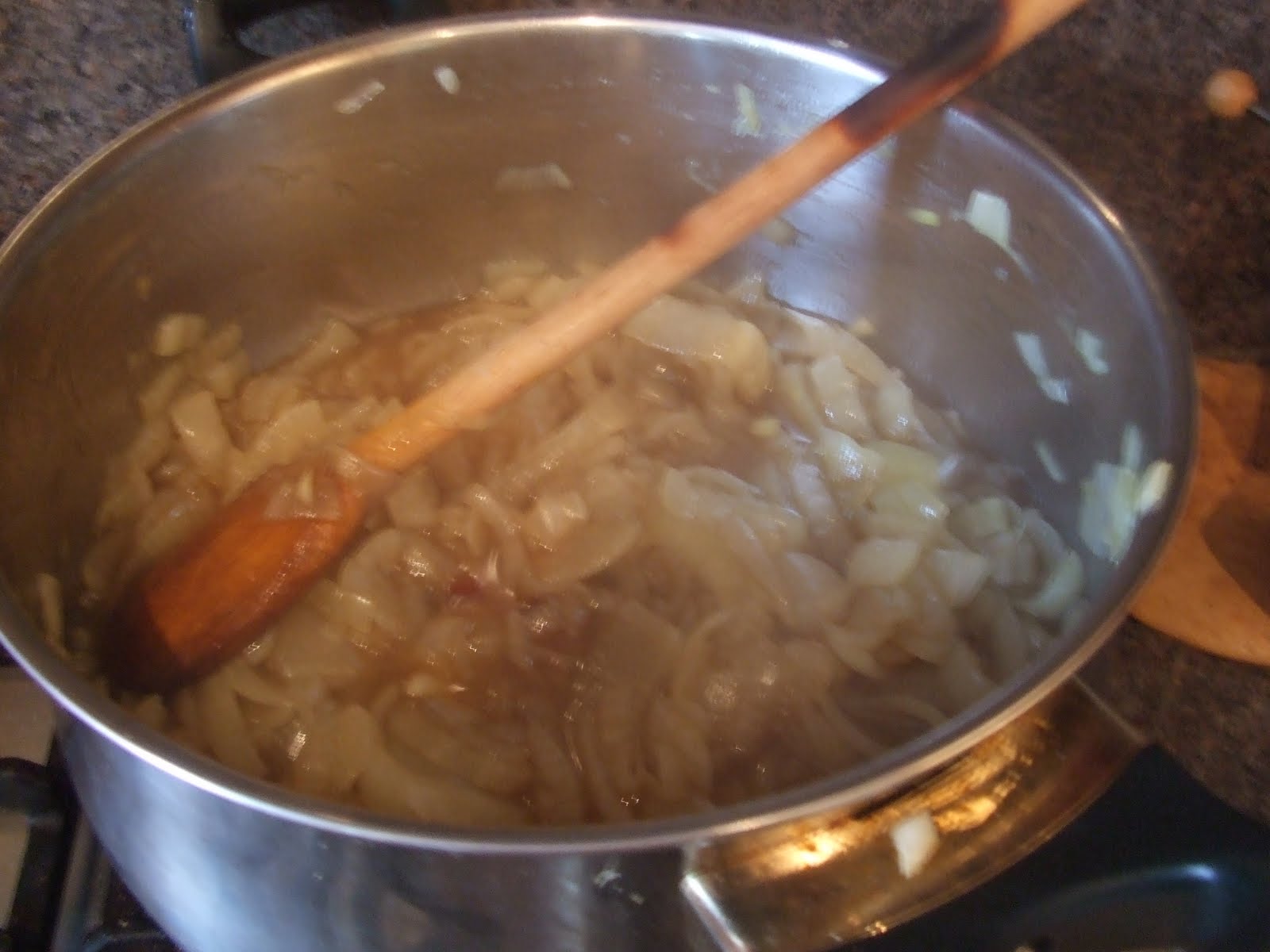
heat the oil in a large pan over a medium heat and add the onions. reduce the heat, cover the pan and cook over a low heat, stirring occasionally, for 30-40 minutes or until the onions have collapsed and begun to colour. like this:

add the sugar and redcurrant jelly. increase the heat and continue to cook, stirring more frequently, for about 30 minutes until the mixture has turned a dark nutty brown and most of the moisture has been driven off.

take off the heat and allow to cool for a couple of minutes before adding the vinegars (if you add vinegar to a red-hot pan it will evaporate in a fury of scorching steam). return to the heat and cook rapidly for another 10 minutes or so, until the mixture becomes gooey and a spoon drawn across the bottom of the pan leaves a clear track across the base for a couple of seconds. like this:

remove from the heat and season with salt and pepper. spoon into warm, sterilized jars and seal with vinegar-proof lids. use within 12 months.

so. that was onion marmalade. not pictured is the massive jar that is already opened and in use. it might seem like an odd thing for a veggie to make, given that it is usually served with pate or cured meat, but it goes really well with cheese, and i can put away a lot of cheese. it is also useful for pepping up gravy, and veggie approximations of gravy need all the help they can get, in my opinion. one of the ways pam corbin recommends using it is swirled through pumpkin soup, and conveniently, my mother got excited at the supermarket and bought me one of the odd 'seasonal squash' specimens they are selling.

here he is. my friend lizzy has a habit of saying 'i love you but i don't know what you are!' a lot and never, in my opinion, has it been more relevant. i have no clue what type of squash this little guy is. it's skin was deep, burnt orange and it was shaped, as you can see, like one of the kremlin domes. lotta seeds, as you can see, but we'll get to that later. if anyone knows what the hell it is, answers on a postcard.

so, to make my soup, i roasted the squash in chunks in the oven, with toasted sesame oil, maple syrup, and a few cloves of garlic (i wonder who gave me the idea of roasting garlic with squash?). it probably took about a half hour. i then popped the squash and the squeezed out garlic into boiling veggie stock, let that be for about ten minutes, and pureed it. the results, were something like this:


i served it with my onion marmalade, and lightly toasted pieces of my homemade bread. i'm glad i went big on flavouring the squash, as it was a slightly watery specimen and wouldn't have done itself any favours as a classic creamed squash soup. here though, it was marvellous. and corbin is right, the tang of the onion marmalade worked amazingly with the sweet smokiness of this little orange bowful. it actually felt really good to know that everything on my plate was made by my fair hand, from start to finish. i love having this kind of working relationship with my food.
also, a note on the seeds: i hate wasting perfectly good food, so i usually roast my squash seeds with some seasoning. i almost always have a tub full of these in the kitchen to pick at as i cook in the winter months. i seasoned this batch with garam masala, coriander, chilli flakes, and rock salt:

it first dawned on me to do this when the ex was having a barbecue for some pompey cup final crap or whatever (back when they still existed, hah) and told me five minutes beforehand that we had a vegetarian coming (this was back in my carefree omnivore days). now, veggie burgers suck for the most part, but that did not stop me wishing we had some in the house. in a flash of inspiration i whipped up both the standard halloumi kebabs, and some foil wrapped squash wedges with chilli and cinnamon butter to roast in the coals. i was making couscous anyway, and was still at the stage of wanting to impress his caveman friends and their airhead girlfriends becauser i hadn't realized what a bunch of posturing tory twats they were, so i toasted the seeds in spices and use them to tart up the couscous. hostess with the mostest? you bet your ass i am.

13/02/2011

Bread, you say?

So I'm sort of muscling in on the bread making, albeit only temporarily.  It's about time I posted something else here, anyway.

I'd only ever made bread a couple of times before, and these efforts were by no means amazing, but also by no means a disaster, to the extent that I have no further recollection than that they happened.  The focaccia recipe from River Cottage Every Day caught my eye when I first bought it, but I'd never got around to making any until my friend Tim told me to 'bring something tapas-y' on New Year's Eve just gone.  Given the circumstances in which one would buy focaccia, ie not just for toast and things I've ended up not really ever having had a bad one, so my standards and expectations of what one should be like were pretty high.  Which made it even more satisfying that the one I made was amazing.  My friend John went to the extent of proclaiming it 'the best bread I've ever tasted'.  And you know what, I probably wouldn't go that far, but it was definitely up there.  It looked amazing as well.  My mum got very jealous (you know, like kids do when they don't get any of something made for a party, which this was) so I was subsequently told to make some more two days later.

So anyway, Tim and his girlfriend Emma just moved into a new flat and dutifully had a convivial evening to warm the place.  I was told to bring focaccia.  I'm not sure if ever my invitation was riding on this, but it's not like I objected or anything.  In fact I took it as an opportunity to try it a little differently.

The original recipe, from Hugh Fearnley-Whittingstall's River Cottage Every Day.

500g strong white flour
10g fine sea salt
5g dried yeast or fast-action yeast (I used dried, it's easier to come by)
2 tbsp rapeseed or olive oil (I used rapeseed, and have done each time I've made this)

To finish:
Rapeseed or olive oil
Flaky sea salt
Leaves from 2 sprigs of rosemary, finely chopped

Put the flour and salt in a large bowl and mix together.  If you're using ordinary dried yeast, dissolve it in 350ml warm water.  If using fast-action yeast, add it straight to the flour.  Add the yeast liquid or 350ml warm water to the flour and mix to a very rough, soft dough.  Add the oil and squish it all in.

Scrape the dough out on to a lightly floured work surface.  With lightly floured hands, knead until it's smooth and silky - anything between 5 and 15 minutes.  As it's a very sticky dough, you'll need to keep dusting your hands with flour; it will become less sticky as you knead.

Shape the dough into a round, put it in a lightly oiled bowl, then cover with lightly oiled cling film or a clean tea towel and leave to rise until it has doubled in size; this will take about an hour.  Knock back the dough and, if you have time, leave it to rise again in the same way.  Meanwhile, lightly oil a shallow baking tin, about 25 x 35cm.

Press the dough out into a rough rectangle on a floured surface, then lift into the baking tin and press right into the corners.  Cover with oiled cling film or a tea towel and leave to rise for about half an hour.

Once risen, use your fingertips to poke rows of deep dimples across the surface.  Trickle the top generously with oil, then sprinkle with salt and rosemary.  Bake in the oven preheated to its highest setting (at least 230°/Gas Mark 8) for 15-20 minutes, turning it down after 10 minutes if the focaccia is browning too fast.  Serve just warm, or let it cool completely.

Variations
Knead some chopped black or green olives and/or sun-dried tomatoes into the dough after the first rising.

Dough pre- and post-rising;


The first two times I made the unadulterated, non-variation version and due to time constraints only gave it one rise.  This time I decided to make two, one normal, one olive variation.  Also thanks to making this while watching the England v Italy Six Nations game, I had time to give both a double rise.  The olive dough needs a second rise in any case after you've kneaded the olives in, otherwise it won't have the required volume to stretch to fill the baking tin.  I also read something somewhere recently (can't for the life of me think where) about how bowls freshly washed in ridiculously hot water transplants heat to the dough and aids rising, so I gave that a try, washing the bowls between mixing and rising.

Finished articles, normal and olive varieties (plus side elevation of olive focaccia to demonstrate just how bloody high it was)


These additional elements resulted in the bread rising during baking about twice as much as the previous two I'd made (and also significantly more than the one pictured in the book).  Both were raging successes.  I took half of each to Tim and Emma's, and they were both demolished.  I think the normal version will always go down better than olive or other variations, which I'd agree with, although that is not to detract from olive focaccia as the combination of oil, salt and rosemary is just perfect and doesn't really need any further embellishment. 

10/02/2011

variables.

so; last week was missing a bread post. and the reason for that is because last week i spent the earlier half of the week either drunk or hungover, due to visiting ed in our country's fair capital (christened by me as Everything Everywhere in some vague conversational sarcastic moment when i was delineating the difference in our living situations, or something. don't ask). well, that and my previous efforts had exhausted 3kg of bread flour, and consequently i had to make a tactical decision on how to vary my endeavours; stick with technique perfection and vary the flour variety? or perhaps try a new technique? i decided, in the end, to stick with the basic technique i have been working with from the river cottage bread handbook, and change up the flour. the reason i went for this decision is because (and this blog is increasingly highlighting this for me, although it's a personality trait i've been somewhat aware of all my life), i do not feel yet that i have achieved a level of skill in the basics that is adequate for me to say i am good enough at it. now i'm just gonna throw the word perfectionist in there, and leave you all to draw your own conclusions. it may also shed light on why every university essay i ever wrote was on books i had already read repeatedly, and why i immediately gave up on things that caused me any great frustration during the learning process in my youth (we're talking guitar and violin lessons, maths homework, the usual suspects here). i have developed a technique of playing almost exclusively to my strengths that helps to shape the way people see me as a person, which isn't news to me, but the fact it's mirrored so strongly in my cooking? that really is.

so anyway, i decided, in keeping with my approach, to go as basic in my variation as to simply try my hand at brown bread, instead of white. there was only one change in the basic recipe suggested for this, and that is that the fat you use should be melted unsalted butter, not oil. it seems counterintuitive to use a gentler fat with a more robust grain on many levels, but brown flour has such a strong, malty character that you need something gentle to soften it.

as per my last batch i took process pictures. it's unfortunate that i don't have anybody else around during the day to help me, i would actually really like to get pictures of things like the shaping process as it's fairly technical and better described pictorially, but obviously my hands are busy, so i can only show you the passive stages of the process, when the yeasts and glutens need to be left to their own devices.


so here is my dough once kneaded. i found a couple of key differences with brown flour. one is that it needs more water than the ratio of 1kg flour = 600ml water to come together properly, but i expected that. i played it by eye so i couldn't tell you how much, but it was somewhere between 50-100ml. the other significant difference is that initially the dough is much more difficult to work with. not just on a resistance level, which, again, i expected, but in terms of the flour being rougher, making it more difficult to see the glutens forming and stretching. you have to work a lot more by feel until they get a bit more well-developed.

and this is my risen dough. i do exactly as the book tells me, popping a carrier bag over the bowl to provide an airtight environment for the bread to rise in, although i have also discovered something which i think gives the bread an extra kickstart, almost by accident. you can plainly see i am using the same bowl i mixed the dough in, right? the more awake among you might have spotted it gets used for almost everything i do; it was the bowl my mother and i used to use when she baked with me when i was little, the only real kitchen experience i had before university. i have a tendency to get attached to things that have absorbed stories, see for reference the fact that when my great grandmother died all i wanted were a few pieces of kitschy seventies china that had long since outlived the set they came in, that i remembered from when i was little. part of it is the literature student in me; i like to surround myself with narrative. anyway, ahem, i digress. obviously in the initial mixing process, the bowl gets all doughy and whatnot, so you have to wash it if you want to reuse it. and i might have mentioned that waitressing and handling glasswasher-fresh glassware have blessed me with asbestos hands? so i wash it in savagely hot water. the earthenware bowl then retains the heat, and gives that extra boost your rising process needs in a february kitchen. that's a lot of tangents for a tiny bit of accidental science i found, right? right.


proving loaf number one, relying purely on belief and a teatowel. what a little trooper. i did have some cotton proving cloths i sewed myself, but i'm not actually sure where i put them, so interdisciplinary bragging will have to wait for another day.

proving loaves number two and three, happy in the support of loaf tins and teatowels. they may have privilege, but i expect all the more from them for it when it comes to crunch time.


LOOK! i am so proud of this batch it's not even funny. again, insta-text to ed about it, who in an understatement of the century said i seem to have an 'affinity' with my bread. call it more like the heart-burning joy i used to get from getting firsts in essays, or acceptance letters, or whatever it was i used to burn myself out for months for. just without the soul destroying low the day after when i realized it wasn't enough. it's really that major a feeling, bringing these little babies out of the oven and thinking 'i did that from beginning to end'. i might sound crazy, but i get a lot of satisfaction from seeing something i have created entirely by myself turn out so beautifully. the little one in back is the freeform proved one, and the one in front is one from the proving baskets.

although, every family has to have its black sheep. this one was baked on the floor of my top oven, to try and get a stonebaked base going on. which totally worked, but as you can see it has tried to exit its' own skin via the slashes. it tasted perfect, and was the first one to get eaten, but it just didn't have the good looks and grace of the other two. i can only think that the heat on the base caused more oven spring in the initial rise so i should have slashed both more, and more horizontally.

still, overall i'm happy with the improvements i'm seeing, and every time i do this i learn more lessons about the process. the bread itself tasted incredible; i actually prefer brown bread anyway but this stuff was glorious, i used it, still warm to mop up the juices from a mixed mushroom pan fry i made out of laziness that was heavy on garlic and butter, and it was so good. fully cooled i've been eating it a lot with brie and honey, cos its flavour profile is a long the lines of oated things; it straddles the line between sweet and savoury, not piling its lot in with either, and therefore working majestically with both.

09/02/2011

cake on a sunday afternoon.

okay, so i'm back. i think my work schedule is both more conducive to spending hours in the kitchen, and spending hours writing about it, than ed's. just one of the many reasons i love my job. another being it's sociable nature, although having said that, i very rarely socialize in this town, because there is nothing to do that interests me, and it's full of too many people i went to school with. i tend to prefer one-on-one time with the people who matter. which is precisely what i was going to do sunday, with my friend laura-jayne (lj for short), who i hardly see these days due to conflicting work schedules and the fact she's glued to skype talking to richard, her boyfriend in the military. my kitchen reputation is starting to precede me at work, and as a result, i was going to make a cake, because really, what better accompaniment is there for wine, cigarettes, and gossip? and i knew it had to be a fairly robust cake, because my lj doesn't do white wine. so i got to flicking through my green and blacks chocolate cookbook and found something i thought would be dark and intense enough, and what happens? we realize we've messed up on organization again, and have to reschedule.

did that stop me making the cake, do you think? no, no it did not. there's always time for cake, and my mother is the biggest cake fiend going. to the point where she sulks if i make cake for anybody except her, you know like little kids do when something is being made for a party or whatever, and they don't get any, so you have to make them some flapjacks to shut them up? like that. hi mum. love you. basically, cake is never going to go to waste in my house. and what better time to make cake than a sunday afternoon? so i banged on fear of music by talking heads and got to work on:

chocolate ginger cake

for the cake:

150g caster sugar

150g unsalted butter

3 large eggs

3 tablespoons of syrup from a jar of stem ginger

150g self raising flour

35g cocoa powder

100g stem ginger, finely chopped


for the icing:

100g crystallized ginger

100g dark chocolate, minimum 60% cocoa solids, broken into pieces


to make the cake, preheat the oven to 180 degrees c/gas mark 4. line the base of an 18-20cm round cake tin with greaseproof paper.


cream the sugar and butter until light and fluffy. add the eggs one at a time, beating well after each addition, then add the stem ginger syrup, and lightly beat again. sift the flour and cocoa, fold them into the mixture, then fold in the finely chopped stem ginger.


pour into the cake tin and bake for 1 hour or until a skewer inserted into the centre comes out clean. remove from the oven and leave in the tin for 10 minutes before turning out onto a wire rack, leaving the paper on. allow to cool before making the icing.


to make the icing, finely chop the ginger. melt the chocolate in a heatproof bowl suspended over a saucepan of barely simmering water. add the ginger and stir well. pour the icing over the cooled cake, using a palette knife to spread it.


so; mine looked a little something like this:


(pictured on my favourite teacup set, bought for me by a very old friend, for those who care about such things). so, i know my photographs aren't the greatest, but i think you can just about see the fact it's darker and denser in the middle? for some reason, even though i aimed for really even distribution, most of the stem ginger seemed to end up in the middle of the cake. this made it sink slightly in the oven, but by the time you pile the spiky, gingery icing on top, that sort of thing doesn't really matter. i can't say i'm precious about cakes like this anyway; i don't think they're supposed to be beauty contest winners, they're more about a dense flavour hit. and this cake was certainly that. i think if i made it again i might actually be tempted by a ganache icing, the ginger then chopped and scattered on top, just because i feel it would meld more effectively with the damp headiness of the cake itself, texturally speaking, but i liked it just fine the way it was. my little brother (i say little, he is 21 and dwarfs me) was a huge fan of this cake. normally he is indifferent to my kitchen potterings but he actually took the time to tell me this was 'good', and was seen shuffling around the house, piece in hand on the regular. this, in terms of food praise, and my brother, is tantamount to a page of liberally-adjectived enthusiasm from a tough-as-nails restaurant critic. i thought it was particularly apt since he was the person who bought me this cookbook (with no parental input, a fact which still shocks me to my core this very day). i also popped some into work for kayleigh, who usually enjoys the things i bake, but as yet i am still awaiting feedback from her; although she hit on the genius idea of serving it with cream. i think i'd be more inclined to go with creme fraiche myself, but given how dark and strong it is, i certainly think some kind of dairy would be a welcome addition.