26/09/2011

This Is My Jam

Wow, it feels like forever since I've been active on this blog. At the moment I'm at one of those pivotal, lifechanging moments in my life, and I think today is the first day I've really had any time to sit down and appreciate the marvellous chaos I'm currently a part of. I'm not too certain on details yet, but regardless of what is happening, this small-town barmaid is a small-town barmaid no more. Things are getting really exciting, and I feel like over the past week I've visited almost all of the south of the country. Still, for the moment I'm back home, and tending my little garden, in which the ripe and unripe tomatoes look like little traffic light dots, and the runner beans are trying to climb the washing line; and I'm feeling good.

I haven't been cooking so much recently, but before this frenzy there came a rut, in which all I did was huddle over the stove, swearing to myself and stirring a la the opening witchy scenes of Macbeth. It wasn't a predicting the future kind of thing, mind, it was a mechanism via which to stay sane in the present. I even got myself back into preserving. Now, since this is what I'll call backlog blogging, I can't say you'll find the ingredients with any relative ease at this time of year; but this is as much a diary for me as a suggestion to my readers, so I'll call this a kind of posterity post.

In keeping with my last post about raspberry and elderflower cupcakes, in early September I was still finding a whole bunch of excellent Summer produce, in glut-sized proportion, for silly money. Again, today, we're talking berries, but this time, the perennial English favourite, the strawberry. Now, wimbledon is over, so I had no problem eating a whole bunch of them with cream, because I wasn't being told to by advertisers everywhere; but I did buy 2kg of the things (they were so cute...I had to), so I needed a more sensible solution to what to do with them.

I decided on the most English of preserves: Strawberry jam. It makes you think of red and white gingham and scones just saying it, huh? I'm not really a gingham kind of girl, but I might fancy playing at being one on any given day, so a few jars of homemade strawberry jam in the cupboard for when the mood strikes me seems like a good idea. Although I'm sure you'll believe me more if I say I've mostly been piling it on toast to accompany a black coffee or seven of a morning.

So anyway, who do you turn to in the case of preserves? Who else but my jarring, bottling, and infusing guru, Pam Corbin? No one else. Obviously. I have nothing but love for her simple, friendly approach to preserving, and sort of want her to adopt me so I can go live with her and preserve all day and sew cool aprons for us to wear all night. So, without further ado, here is my very picture heavy approach to strawberry jam, taken from her River Cottage Preserves Handbook:

Strawberry Jam

makes 4-5 340g jars

1kg strawberries, hulled, larger ones halved or quartered
500g granulated sugar
450g jam sugar (it's labelled as such and has added pectin which helps the set)
150ml lemon juice

Put 200g of the strawberries into a preserving pan with 200g of the granulated sugar. Crush to a pulp with a potato masher. At which point it will look like this:


Place the pan on a gentle heat and, when the fruit mixture is warm, add the rest of the strawberries. Very gently bring to a simmering point, agitating the bottom of the pan with a wooden spoon to prevent the fruit from sticking. Simmer for 5 minutes to allow the strawberries to soften just a little. At which point it will look like this:


Add the remaining granulated sugar and the jam sugar. Stir gently to prevent the sugar sticking and burning on the bottom of the pan. When the sugar has dissolved, add the lemon juice. It'll look a bit like this:

Increase the heat and, when the mixture reaches a full boil, boil rapidly for 8-9 minutes. Then test for setting point. (I do this by dropping some onto a cold saucer and poking it with a finger to see if it puckers; if it puckers it's ready). Mine looked like this at setting point:
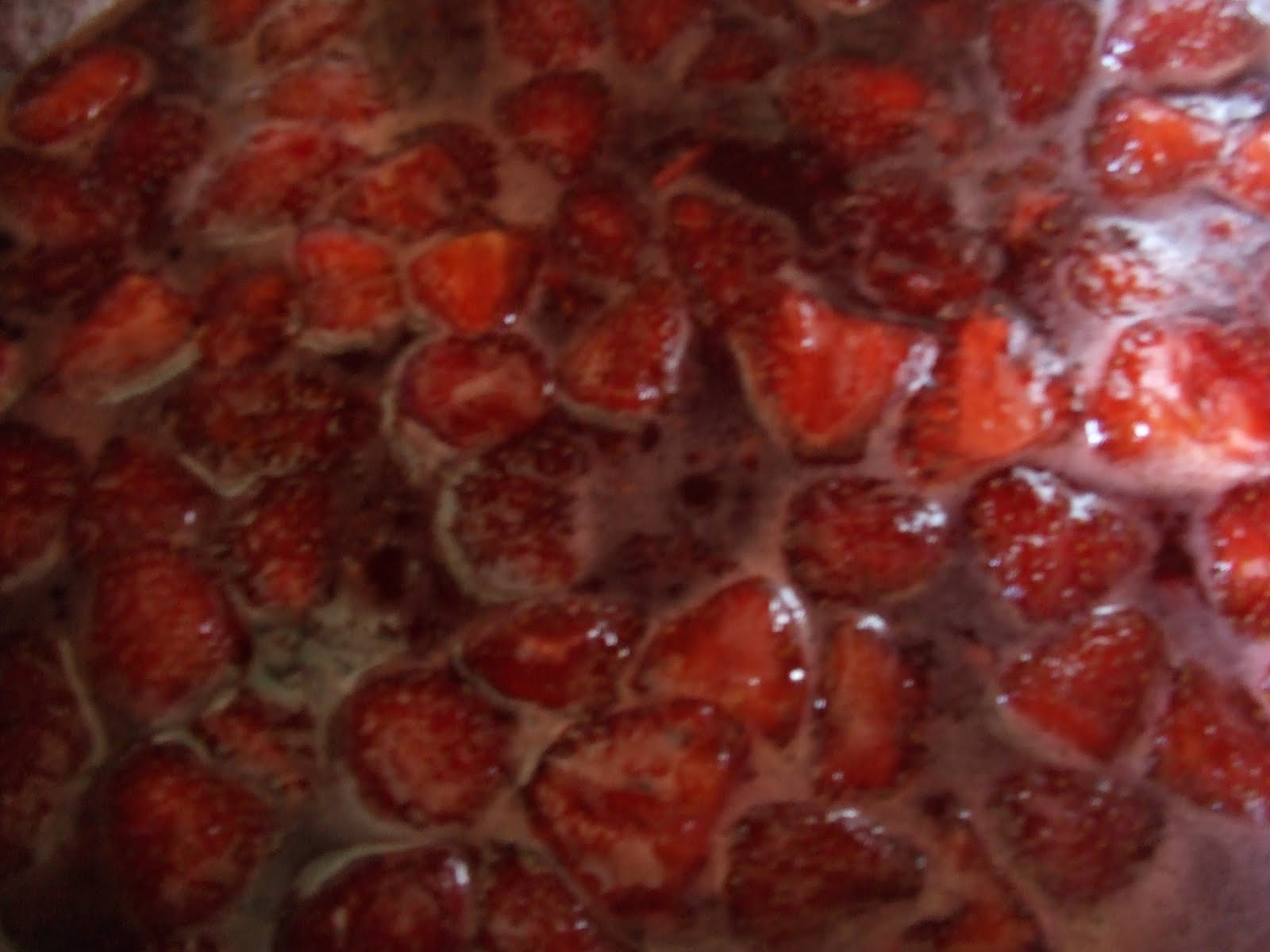

Remove from the heat and, if the surface is scummy, stir gently to disperse. Pot and seal. Use within 12 months.

So that's strawberry jam. i forgot to take4 pictures of the potted and sealed jam because I am something of an airhead, but you get the idea. I only got two jars, because one of them was disproportionately large (previously containing mayonnaise. Whoever tells you you can't recycle jars for preserving is probaboly in the glass industry, because I'm telling you now that you can, and you should if you give two fucks about the environment)

My jam was really nice; I have been eating it on toast for breakfast every morning I've woken up in my own bed (and there are pluses and minuses to this scenario: the strawberry jam on toast being one of the pluses). I am not really a strawberry jam aficionado; since when I was little, which seems to be the halcyon jam eating days in most people's lives, my heart belonged solely to apricot, but this is definitely better than the shop-bought stuff by a mile. The only problem with my jam was that the fruit seemed to float to the top of the jars, which according to Pam means I didn't take quite enough care dissolving the sugar before bringing the mixture to the slightly scary high-speed boil it needs before it becomes jam. It would seem I still have a way to go before I can be her preserving/apron-making apprentice extraordinaire, but in the meantime I have the wherewithal, should i want to, to make scones and victoria sponges all winter long. And who doesn't want to do that?

08/09/2011

I'm Somewhere Inbetween

So you know how I made all that fuss at the beginning of summer about how I was going to miss slow cooking and afternoons in the kitchen and big bold winter dishes? Well, summer is drawing to a close and I'm finding myself not quite ready to give up on delicate, barely-cooked food picked straight from the garden. I find there's just no pleasing some people. More often than not, I find I'm one of them. I come most alive during periods of transition; when there's the promise of new challenges and scenarios but the old ones are still, comfortingly, in play. I don't so much like change, as the possibility of it; I've always been obsessed with potential. I guess that's why I'm currently happier in my kitchen than anywhere else. The hedgerows are starting to come alive, and I'm picking damsons and blackberries almost everywhere I walk in the villages, but I've still got tomatoes and courgettes and beans ripening in the garden. Autumn is coming but it's very easy to keep Summer alive.

The shops, at the moment, seem to be aiding and abetting my pleasure in indecision. The erratic Summer we've had seems to be affecting not just my garden, but the country as a whole. Some of the best 'summer' produce I've bought has been in the last week or so: late varieties of every type of berry and currant you could conceivably imagine; stunning courgettes and beans; all cheap, plentiful, and wonderful. So i can't help it if my mind is somewhere in July, can I? My surroundings are conspiring to help me.

Now, most of the aforementioned berries and currants were eaten raw, or made into simple compotes and eaten over yoghurt at what I, the nocturnal barmaid, have the gall to call breakfast time. But when you're buying perishables in glut-size lots, you have to vary up how you eat them pretty quickly or you're going to end up wasting them, or getting bored shitless with them, or both. So, when faced with the third perfect little punnet of raspberries after days and days of raw raspberries and yoghurt, I knew I had to make them into something that I would, and more importantly, a lot of other people would help, eat. And quickly.

Now I'm not sure about anyone else round here, but when it's a question of food and mass appeal, the answer, to my mind, is pretty much always cake. Everyone likes cake. Well, this is not strictly true, but everyone I've ever met who has professed to not like cake has been so wilfully miserable and stubborn that I've not kept them around very long. So, to put it another way; all of my friends like cake. If I make it, they will eat it. So I grabbed my punnet of raspberries and got myself flicking through Harry Eastwood's Red Velvet and Chocolate Heartache, and found the perfect 'I'm not letting go of Summer and you can't make me' recipe:

Raspberry and Elderflower Cupcakes

2 medium free-range eggs
140g caster sugar
200g topped, tailed, peeled, and finely grated courgette
3 tbsp elderflower cordial (sadly, not home made as I missed the elderflowers this year, but I had this knocking around from making pitchers of lovely Plymouth Lemonade to get drunk on)
80g white rice flour (I used plain, you're allowed to substitute it)
120g ground almonds
2 tsp baking powder
1/4 tsp salt (I omitted this; I don't often salt cakes unless they're chocolate)
120g fresh raspberries plus 12 extra ones for the tops

For the icing:

140g icing sugar
3 tbsp elderflower cordial

Preheat the oven to 180 degrees c/gas mark 4 and line a muffin tray with paper cases (note, I found this recipe created 18 cakes, so I lined an extra six hole tray).

Whisk the eggs and sugar in a large mixing bowl for 5 minutes, until pale and quadrupled in volume.

Add the grated courgette and the elderflower cordial, and whisk again. Mix in the flour, ground almonds, baking powder and salt until they are well introduced. Gently fold in the raspberries, taking care not to crush them up too much.

Spoon the mixture into cupcake cases, and place in the oven for 25 minutes until risen and cooked. Don't be alarmed that they are flat on the top rather than dome shaped. This is perfectly normal.

Cool the cupcakes for 15 minutes while you make the icing. Sieve the icing sugar into a small mixing bowl. Add the elderflower cordial and mix until it forms a loose white icing. Add colouring if you want to use it.

Ice each cake individually and top with a raspberry.

And here are mine:


Cute little things, aren't they? I have to admit that even as a 23 year old girl I still get just a tiny bit delighted when things I make look like illustrations from children's books. It reminds me of the time when in Brownies I had to host a tea party to get my hostess badge (you're damn right I've got a badge in hostessing; I got one at Guides too), so I went through a load of kid's books, being a kid at the time, along with my mum's Beginner's cookbook from the seventies, in order to work out what a tea party looked like and involved. I remember being very impressed when the cakes I'd made looked like the ones in a picture from a book about kittens having tea. I dare say these little things wouldn't have looked out of place on the kittens' pastel tea party table, either, so I am just as pleased with myself this time.

Still, a busy girl like me uses her hostess badge skills behind a bar these days, so I don't have time for tea parties. Instead I took a whole bunch of the cakes to work to give to my coworkers, who received them with pleasure. they were marvellous tasting little things, and i enjoyed the cook's share of them before work (and after work), with a pot of rose infused tea. But I didn't go so far as trying to share it with my cats. Village life hasn't got to me that badly yet.

24/08/2011

The Centre Cannot Hold.

I haven't been doing much cooking at all lately. I could pretend it's the summer heat, that I've been busy at work, that other things have gotten in the way; but actually I've just been really down at heel and not really doing anything at all. I occasionally get into a headspace, when things get difficult and I feel directionless, where I just stop. It's like going into shutdown to preserve energy; I just about manage the essentials of living like going to work and getting dressed in the morning, but that's really about it. Which explains why you haven't heard much from me lately. I've been busy drinking gin and staring into space as a kind of complementary activity to the life-evaluating that is constantly going on in my brain at the moment.

I actually made the recipe I am going to tell you about today a week ago, maybe even two. I was given some beautiful, huge, pale green courgettes by my American friend Ed (who seems to be getting regular shoutouts in pretty much everything I write about food these days). I've been eating a lot of courgettes of late, since my garden is producing tiny, beautiful bright yellow ones every other day and pretty much every restaurant meal I've eaten has involved them in some way, so I wanted to deviate a little beyond my usual approach of grilling them and eating them with oil, salt, and lemon juice. I mean, it works superbly well, and is a brilliant minimum effort way of plot-to-plate cooking in under ten minutes, but I wanted to try using courgettes in a way that felt more substantial for a change. So, I turned, as I seem to be doing with rapidly intensifying frequency, to Ottolenghi. I know this blog is basically in danger of becoming Kirsty rhapsodizing about every single recipe in Plenty; but I wouldn't do it if the recipes weren't so good. He has a lot of courgette recipes, but I plumped for this one:

Pasta and Fried Courgette Salad

150ml sunflower oil
3 medium courgettes, cut into 5mm thick slices
1 1/2 tbsp red wine vinegar
100g frozen baby soya beans
50g basil leaves, shredded coarsely
15g parsley leaves
75ml olive oil
250g strozzapreti (which Ottolenghi oh-so-generously suggests you can sub for any short interestingly shaped pasta, handy if you're a hick from the sticks like me)
grated zest of one lemon
1 1/2 tbsp small capers
200g buffalo mozzarella, torn by hand into chunks
salt and black pepper

Heat up the sunflower oil in a medium saucepan. Fry the courgette slices in a few batches, making sure you don't crowd them, for 3 minutes, or until golden brown on both sides; turn them over once only. As they are cooked, transfer to a colander to drain. Tip the courgette slices into a bowl, pour over the vinegar and stir, then set aside.

Blanch the soya beans for 3 minutes in boiling water; drain, refresh under cold running water and set aside to dry.

Combine half the basil, all of the parsley and the olive oil in a small food processor bowl, adding a bit of salt and pepper. Blitz to a smooth sauce.

Cook the pasta in boiling salted water to the al dente stage; drain the pasta, rinse under a stream of cold water and leave to dry. Return to the pan in which it was cooked.

Pour the courgettes and their juices over the pasta. Add the soy beans, basil sauce, lemon zest, capers and mozzarella. stir gently together, then taste and season with plenty of salt and pepper. Before serving, stir in the remaining basil.

So here's mine:


As you can see it's your typical Ottolenghi colour and ingredient fest, but actually it might just be the nicest pasta salad I have ever eaten. I don't say such things lightly, since my early teens I've been something of a pasta salad fanatic, and positively fume at the horrendous crimes committed in their name by supermarkets and thoughtless cooks. I like mayonnaise as much as the next person, but I'll pass on eating a bowful of it, ta. The vinegar on the courgettes is actually a stroke of genius; it brings out their natural sweetness and lets them really sing; which is no difficult feat in a dish with strong flavours like capers and basil going on. On that note, I would suggest the the mozzarella provides a kind of respite for the palate with it's milkiness, but I wouldn't say the dish would suffer any huge loss for its omission if there was a necessity to veganize it. If my courgette harvests continue at the rate they are I think this recipe will likely become a bit of a fridge mainstay until the end of september, as it keeps pretty well.

10/08/2011

When life gives you plums...

I had an early meeting at work the other day (yes, in the licensed trade I do sometimes still have to haul my arse out of bed in the morning, but not nearly so often as you 9-5ers). As I blustered in, I bumped into Lorraine, our cleaner and kitchen porter, who asked me if I liked/wanted some plums. I said yeah, and was immediately granted a bowlful, which perched next to me while I went through paperwork and projects with my training officer:


Now, that might seem like an odd little setup for a work meeting, I guess. But it makes more sense if you consider that my passion for food, gardening, and cooking is gaining repute throughout the village I work in and the community I serve. And that Lorraine's neighbours tree was fruiting at the time, so she had a huge carrier bag of the things with her. I'm often gifted with foodstuffs to 'make something with' at work these days, and I'm always happy to take it, and bring in some of the results to share with my coworkers and friends. I like the idea of food creating community, and community creating food.

So I cycled home, to leaf through my cookbooks and find something to make with the plums. I wanted something to fit the season, not too heavy or wintery, and bizarrely, the only thing i could find that didn't resonate with sitting down in knitwear in a heated house was Nigella Lawson's Winter Plum Cake, from How to be a Domestic Goddess. She calls it a winter cake because it's made with tinned plums (something I sort of shudder to think of, sorry to say) so I figured whipping one up with fresh plums would be enough to take the Winter right out of it. and that is exactly what I did, and here is my adapted recipe:

Not-so-Wintery-Plum-Cake

for the cake:
567g tin red plums (or the unweighed amount of fresh, stoned plums i had, which must have been about the 600g mark)
125g self-raising flour
1/2 teaspoon of baking powder
75g ground almonds
125g butter, softened
125g light brown sugar
2 large eggs (keep it organic and free range, people)
1 scant teaspoon almond essence
20cm springform cake tin, buttered and lined.

for the icing:
160g unrefined icing sugar
1-2 tablespoons hot water.

preheat the oven to 170 degrees c/gas mark 3.

Chop your plums. I went for 2.5cm dice, which seemed to be fine, although if you're worried about uneven distribution, chop them as fine as you see fit. Leave aside. Mix the flour, baking powder, and ground almonds. Cream the butter and sugar, then beat in the eggs, adding a tablespoon of the flour mixture after each one. Beat in the almond essence, then fold in the rest of the flour mixture and the drained, chopped plums. Turn into the prepared tin and bake for about 1 1/4 hours, though check at 1 hour. When it's ready, coming away from the sides of the tin, take out of the oven, leave in it's tin to cool for ten minutes, then turn out onto a wire rack.

When cool, ice with brown sugar icing, which you make simply by mixing the sieved icing sugar with water til you have a caramel coloured paste. pour over the top of the cake to cover thinly, not necessarily uniformly, and leave to drip, here and there, down the sides.

So here it is:

I was quietly proud of this cake, it's by no means an elegant confection, but it has the kind of country cooking charm that's totally appropriate to how I obtained it's principal ingredient. It tasted amazing; the plums were tart and contrasted beautifully with the marzipan-like taste and texture of the sponge; i'm not sure I'd bother making this with sweetened tinned fruit having tried it in this incarnation. It was the perfect unfussy cake to serve in huge wodges with mugs of coffee (some cakes are tea cakes, and some are coffee cakes; i don't make the rules; I just obey them). I took a slab of it down to work with me to share with my coworkers; and it went down a storm. Using cake to win friends and influence people? Maybe, but whatever works.

08/08/2011

Greener Pastures

So I'm still in the throes of a non-cooking kind of cooking,. I'd make excuses, but it's oppressive here in the midlands, and I work in a polyester uniform so I am really feeling it. I have noticed since becoming vegetarian, that summer cooking is both easier and harder. You can't rely, any longer, on one centerpiece, say, a poached salmon or roast chicken, and quickly prepared, raw-or-almost-raw accompaniments to make a meal. You can, however, get dinner on the table far quicker, as vegetables tend to respond better than most meats to a preparation that is almost nil. I have been almost exclusively living on cute little yellow courgettes from my garden, grilled, fried, shaved raw into a lemon and herb dressing; chucked into pasta, quinoa or couscous. This is part laziness, part response to a glut, and part because it's really all I want to eat. I mean, I'm running around like a headless chicken behind a bar, cycling to get everywhere, and digging myself exhausted in the garden; the very last thing I need is food that weighs on me like a rock.

However, sometimes, surprisingly, I run out of courgettes. So I've been finding other, fussless recipes for something light but satisfying, and have reverted back to my student habit of big-batching bowfuls of the stuff and keeping it in the fridge for whenever I feel like grabbing a plateful. It's a kind of cooking and eating that satisfies my internal unstructured forager instincts, without me resorting to standing in front of the fridge repeatedly eating the odd bit of cheese, or olives, or whatever, and ignoring dinner (if left to my own devices long enough this is exactly the kind of behaviour I consider to be normal, and don't even act like you don't do it too).

Now that Ottolenghi and I are buds again, I've been hitting his cookbook up regularly. There are Plenty (you don't have to think I'm funny, but it helps) of recipes of his that use bunch after bunch of summer produce, to the point where I feel like I'm racing against the calendar to try as many as possible before the weather starts to turn and I find myself back in the season for funghi, winter squash, and roots. This one perfectly fits my current 'why make the kitchen hotter than it has to be?' mood, and might just be the best looking and tasting couscous I have ever eaten:

Green Couscous

150g couscous
160ml boiling water or vegetable stock
1 small onion, thinly sliced
1 tbsp olive oil
1/4 tsp salt
1/4 tsp ground cumin
50g shelled unsalted pistachios, toasted and roughly chopped
3 spring onions, finely sliced
30g rocket, chopped

Herb Paste
20g parsley
20g coriander
2 tbsp chopped tarragon
2 tbsp chopped dill
2 tbsp chopped mint
90ml olive oil

Place the couscous in a large bowl and cover with the boiling water or stock. Cover the bowl with cling film and leave for 10 minutes.

Meanwhile, fry the onion in the olive oil on a medium heat until golden and completely soft. add the salt and cumin and mix well. Leave to cool slightly.

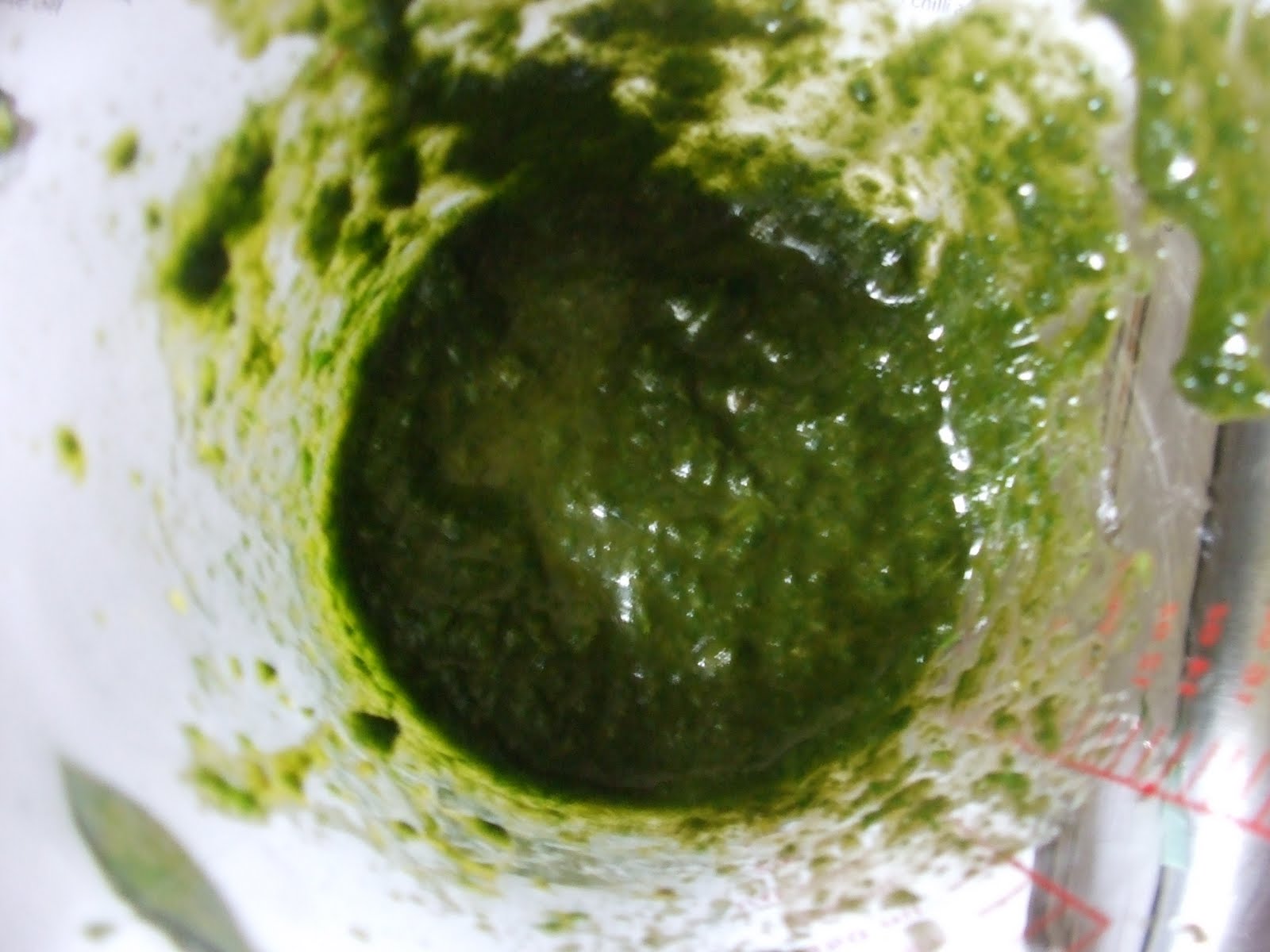
Next, make the herb paste by placing all the ingredients into a food processor and blitzing until smooth. Here's a picture of mine, whipped up in a measuring jug with my trusty stick blender:


One of the things I love most about Ottolenghi's recipe's are the use of colour-who could fail to smile at creating something such a deep, froggy, fresh-cut-grass green?

Add this to the couscous and mix everything together with a fork to fluff it up. Now add the cooked onion, the pistachios, spring onions, green chilli and rocket, and gently mix. serve at room temperature.

Here we have it:


Again, I totally love the use of colour; I really think the single-focus devotion to green is something to admire. This was ace eaten by the bowlful with a little bit of feta crumbled on top as a whole meal, but i think it would also totally work as a side dish for little burek or spanakopita, or any number of the Small Fried Things I like to cook on a regular basis. The flavour of the herbs and greenery in this dish is strong, almost medicinal, but in a good way, and totally enhanced by the pep of rocket, so I think it would make the ideal foil for cutting through salty foods, hence the feta. Another great point to note about this dish is it perfectly matched the grassy, slightly acidic New Zealand Sauvignon Blanc that I seem to be drinking by the bucketload this summer. I thought it would be an okay bedfellow but it's turned out to be a match of marriage material proportions. And anything that's an excuse to crack open a bottle is a keeper in my book.

04/08/2011

All That Glitters

Even as someone who would undoubtedly rather be cooking than doing anything else, I have no trouble admitting that it's sometimes very difficult to cook in summer. When it's hot outside, there are so many other things that demand your attention; the garden, work being busier, people suddenly feeling a lot less like sitting inside watching dvd boxsets all day. Not to mention the fact that it's quite frankly, too hot to want to be stood over a stove all afternoon. So I tend to find in summer, that I eat things I can throw together quickly, composed primarily of raw ingredients. Probably not even interesting enough to be termed salads, for the most part. Not exactly the kind of thing people want to be reading about; although it keeps my tumblr followers in 'Things I Ate' pictures. If they like that sort of thing.

Nevertheless, there is one form of cooking that will keep me in the kitchen, and that, my friends, is baking. While I was compiling our snazzy new Recipe Index, I noticed the alarming amount of baked goods I actually churn out. I say alarming, only because I was alarmed that the number is only, realistically, about half of what I actually bake, since i haven't included repeats of recipes. My hand is near permanently glued to the whisk, my devotion to the ritual of ingredients so strong that when making lemon drizzle cake, I looked at Ed like he was insane for suggesting the creamed butter and sugar had 'probably been beaten enough', and I had the gall to correct Hugh Fearnley Whittingstall's directions on how exactly to add eggs and flour. Ed's 'I think this has risen more than last time' elicited only a wry smile from me. Of course it had. We'd done it my way. It's taken me half a year's worth of reflection on exactly what I cook and when to realize that baking is so second-nature to my day-to-day routine, that it's so ingrained and habitual, that at the tender age of 23 I already have something of the cooking traditionalist about me. Which means I have a cooking tradition. Which means I can be proud. and proud I certainly am.

Tradition, however, gets stale quicker than baked goods left on a countertop uneaten. So it was with a mixture of fear and excitement that I embarked upon my first trials of the recipes in Harry Eastwood's Red Velvet and Chocolate Heartache. The reason the recipes in this book are so deviant is because rather than using butter in her recipes, Eastwood uses grated or pureed vegetables. This is ostensibly for dietary purposes, something I inherently disapprove of (especially since the book is so unsubtly marketed toward women), but I figured, hey, I won the book, and finding out new things about the properties of vegetables will be a learning experience my baking could benefit from. So after carefully deciding which of the recipes I'd dogeared in my initial reading to make, I whipped out the cheesegrater and got busy:

Courgette and Chamomile Cupcakes

Makes 12

2 medium, free-range eggs
120g caster sugar
finely grated zest of 1/2 a lemon
200g topped, tailed, peeled, and finely grated courgette (I used a yellow one from my garden)
5 camomile teabags (I used pukka's chamomile and vanilla blend; and I buy most of my herbal teas from them, not because i necessarily buy into ayurveda, but because they're the best tasting ones I've found)
150g white rice flour (all the recipes in this book are wheat free but lazybones like me can sub plain white flour)
50g ground almonds
2 tsp baking powder
1/2 bicarbonate of soda
1/4 tsp salt (i don't often salt my baking, unless it's chocolate, so i ignored this)

for the icing:
3 tbsp strong chamomile tea (use one tea bag and 100ml boiling water)
2 tbsp freshly squeezed lemon juice
160g icing sugar, sieved

you will need:
a 12 hole muffin tray
12 cupcake cases

preheat the oven to 180 degrees c/gas mark 4. line the muffin tray with the paper cases.

in a medium-sized mixing bowl, whisk the eggs and sugar for 3 minutes until fluffy and pale. first add the lemon zest and courgette, and give it a whisk until fully incorporated. Next, tip the chamomile out of its teabags (it comes out as a fine powder) into the egg and sugar mixture, and add the flour, ground almonds, baking powder, bicarbonate of soda, and salt.

once all are well mixed in together, ladle the mixture evenly into the cupcake cases so that it comes four fifths of the way up the sides. Bake for 30 minutes.

Remove the cupcakes from the oven and cool on a wire rack for 15 minutes.

To make the icing, mix the chamomile tea and lemon juice with the icing sugar in a small bowl until you reach a white, paste like consistency. Ice the cupcakes with the back of a spoon (dipping the spoon into the surplus tea makes it easier)

So here are mine:


Note that I couldn't resist trialling the edible glitter I got in the same Iron Cupcake Victory as the book. I sort of angsted about these while they were baking. I wasn't entirely sure they'd have the same rise and great texture I'm normally so proud of in my baking. But my doubts were assuaged, as these little beauties came out just perfect. The texture of the crumb was actually really springy; and the courgette and ground almond kept it moist. They tasted amazing; the chamomile flavour was a lot more pronounced than i thought it would be, even in the icing, and since i have something of a fetish for the more floral flavours, I was in cake heaven. i took some down to work, upon which kayleigh, my kitchen manager exclaimed that she wants these as her wedding cakes (despite not being engaged), and my American friend Ed deciding that these were excellent enough to brag to half the village about. I'm still answering questions about them when I turn up at work now. I'm looking forward to trying other recipes from this book in the near future, as there are countless other techniques using vegetables i want to try; like using parsnips or beetroot to make fudge, and using aubergine in a dense chocolate torte.

02/08/2011

About face

As I started writing this post before the last one, I was originally going to go on about how long it had been since I'd last posted.  As it is, a couple of weeks between posts seems relatively prolific given the time there was between the previous two.  But what will remain the same is that as this is going to be another meat curing post, I should start off by addressing the broken promise that I made after my last foray into this subject, my home-cured salami. (here for a quick refresh.) It's about four months since I actually made the stuff, approximately eight weeks of which was spent hanging in my cellar gradually hardening, slightly shriveling due to my overly cautious first approach to hand stuffing natural animal casings (or any other casings, come to that matter) leaving a bit too much space inside, and getting excited by the development of little white specs of mould.

Ultimately I think eight weeks was a bit too long.  The texture in the very middle is just about perfect - quite soft and giving.  When you slice it you can see the fat start to glisten (especially on the one that's sort of chorizo, but isn't really), and although it's a bit of an odd shape (license to be firmer with the casings next time, they're stronger than they appear) it actually looks like salami.  And also, they both taste really good, too, which of course is the most important thing.  The flavours are distinct enough, in one the fennel really comes to prominence, in the other the smoked paprika pervading and providing a vibrant red colour.


It is always tempting to just eat it straight up, but the flavour it has when cooked is pretty damn impressive.  Initially I just stuck some on a homemade pizza.  Do pardon my modesty if I say it was amazing.  (It was).  I also made something from the hip that was sort of based on Jacob Kenedy's Orecchiette with 'Nduja, a dish I had at on my second visit to Bocca di Lupo.  Mine basically consisted of salami finely chopped and fried with red onion and garlic, then adding some sliced aubergine and halved cherry tomatoes before tossing through some paccheri pasta.  It lacked the richening sauce from the wine and cream of the original dish, but the melted fat from the salami distributed a deep, winey, meaty flavour throughout, with occasional hits of fennel.  I think I may have to work on it and there's something pretty good in there.  I still have designs on cooking some variation of razor clams with chorizo, which hopefully will happen at some point soon.

So onto the second part, as I said, this belated salami update was only part of the parcel. 

I first came across guanciale in Kenedy's The Geometry of Pasta, where he describes it as "a fatty, porcine treat, hard to find but worth seeking out."  And if it's worth seeking out, then there's a good chance it's worth persevering with making your own for several months.  Guanciale is the jowl of the pig, or in simple terms, its face.  Cheek, specifically.  Pig's cheeks are amazing, one of my first attempts at making pasta was a pig's cheek ravioli where I cooked the cheeks for several hours until the meat fell apart but was able to come together as little lumps of pasta filling from all the sticky, gelatinous fat in and around it.    As a cut of meat it's at least half fat, probably more 65% - 35% fat to meat.  So of course I wanted to try curing it at some point, and it seems ideal for doing so.


Up to this stage all my efforts at curing have come with a reassuring helping hand from Hugh Fearnley-Whittingstall, but neither The River Cottage Meat Book nor The River Cottage Cookbook offers any sort of guide for curing pig's cheeks.  Neither does Kenedy's Bocca, a book which is so amazing on all other levels I shall forgive it.  So this is where the theory of doing things over so you know the basics well enough to be able to wing it on other things comes into play.  The sort of thing that someone impatient with a short attention span doesn't bother to do.  Like me.

Nonetheless, I kind of did that, but just used my one bacon curing as the basis.  I used the flavoured cure mix that I had been planning on using for the second round of bacon curing, which never actually materialised.  As a much smaller cut than a 2kg pork belly, I thought it must probably take less time to apply the cure in the initial stage.  As for hanging and air curing, I had a bit of a gander around the internet and found that Michael Ruhlman suggests hanging it for two months.  Michael Ruhlman co-wrote The French Laundry Cookbook (as well as Thomas Keller's other books), and was one of the disciples on Anthony Bourdain's pilgrimage to The French Laundry, so by association his opinion will do nicely.

Anyway, the cure mix was as follows;

1kg salt
1kg demerera sugar
25g ground black pepper
20 juniper berries, crushed
a few bay leaves, chopped


So I repeated the same process of applying a rub of cure mix each day for just under a week, then rinsing it off, patting dry and hanging, although whereas the bacon hung for about a week, this will hang for up to two months.  As of now, it's been up about a month.  I already can't wait for it to be ready, and it may be hard to resist temptation to take it down early at the expense of a bit more flavour maturation.


The prospect of my own pasta combined with unctuous, heavy, pork fat is quite something.  Whereas with the salami I pretty much made it just because I wanted to, and it was quite an obvious thing to cure and as such didn't really have anything specifically planned for its use.  With guanciale on the other hand, I'm already accruing recipe plans, all involving making pasta as well, so there shouldn't be much excuse to not go on and on about it afterwards.